How Artificial Intelligence Works: A Simple Guide for Beginners
You use AI every single day, when Google predicts what you're about to type, when Spotify builds your playlist, or when your bank flags a suspicious transaction before you even notice it.
But have you ever stopped and wondered: how does it actually work?
Most people imagine AI as some kind of magic or science fiction. The reality is far more fascinating, and surprisingly understandable, even without a tech background.
In this guide, we'll pull back the curtain and explain exactly how AI works, step by step, in plain English.
AI Starts With Data - Lots of It
If AI has one secret ingredient, it's data.
Humans learn from experience. A child touches a hot stove once and learns not to do it again. AI learns the same way - except instead of physical experience, it learns from data: text, images, numbers, audio, video, and more.
The more high-quality data an AI system is trained on, the smarter and more accurate it becomes. ChatGPT, for example, was trained on hundreds of billions of words from books, websites, and articles across the internet.
Think of data as the raw fuel that powers everything AI does.
The Three Core Technologies Behind AI
Once you understand these three building blocks, AI stops feeling like magic.
1. Machine Learning - Teaching Machines to Learn
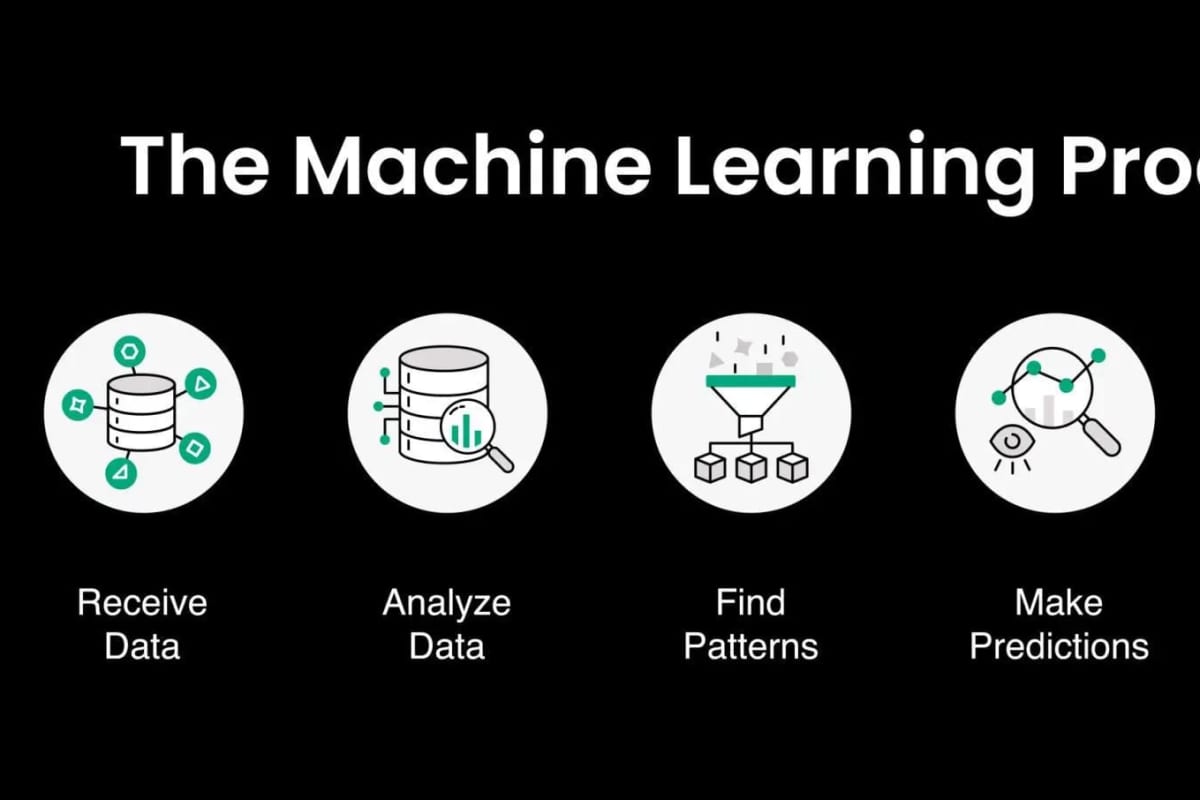
Traditional software follows strict rules written by programmers. Machine learning is different - instead of writing rules, you feed the system examples and let it figure out the patterns itself.
Here's a real example: imagine you want to build an AI that detects spam emails. Instead of writing rules like "if the email contains the word 'free money', mark as spam," you simply show the AI thousands of spam emails and thousands of legitimate ones. Over time, it learns the difference on its own - and gets better with every new example.
That process of learning from examples is called training.
2. Neural Networks - Inspired by the Human Brain
Machine learning becomes far more powerful when it uses neural networks - systems loosely modeled on how the human brain processes information.
Your brain has billions of neurons connected by synapses. When you learn something new, those connections get stronger. Neural networks work the same way - they have layers of artificial "neurons" that pass information to each other, adjusting their connections based on what they get right and wrong.
The more layers a neural network has, the "deeper" it is - which is where the term deep learning comes from.
3. Natural Language Processing - Understanding Human Language
NLP is what allows AI to read, write, and understand human language. It's the reason you can type a question in plain English and get a coherent, relevant answer back.
NLP involves teaching AI the structure of language - grammar, context, tone, meaning - so it can process and generate text that sounds natural.
Without NLP, tools like ChatGPT, Google Assistant, and AI writing tools simply wouldn't exist.
How AI Actually "Learns" - Step by Step
Here's what happens under the hood when an AI model is trained:
Step 1: Feed training data Images, text, numbers, audio Step 2: Make a prediction Model guesses an answer Step 3: Measure the error Compare guess to correct answer Step 4: Adjust and improve Update weights, repeat millions of times Click any step to explore furtherThis cycle repeats millions, sometimes billions, of times during training. Each repetition makes the model slightly more accurate, until it reaches a level of performance good enough to deploy in the real world.
A Simple Real-World Analogy
Imagine you're learning to play darts for the first time.
You throw a dart - it misses. You adjust your aim slightly. Throw again - closer. Adjust again. After hundreds of throws, your muscle memory kicks in and you start hitting the bullseye consistently.
AI training works exactly like this. The "throws" are predictions. The "adjustments" are weight updates inside the neural network. The "bullseye" is the correct answer. The only difference is that AI can do this millions of times per second.
What Happens After Training - Inference
Once an AI model is trained, it moves into a phase called inference - this is when the model is actually used in the real world.
During inference, the model no longer updates itself. It simply takes new inputs and produces outputs based on everything it learned during training. When you type a question into ChatGPT and get a response in seconds, that's inference happening in real time.
Training is slow and expensive. Inference is fast and cheap. That's why AI tools feel so instant to use, even though the work behind building them was enormous.
Why Does AI Sometimes Get Things Wrong?
AI is powerful, but it's not perfect. Here's why it makes mistakes:
- Biased training data - if the data used to train an AI is biased or incomplete, the AI will reflect those biases in its outputs. Garbage in, garbage out.
- Hallucinations - AI language models sometimes confidently state things that are completely false. This happens because the model is generating text based on patterns, not actually "knowing" facts the way humans do.
- Out-of-distribution inputs - AI performs best on data similar to what it was trained on. Give it something very different and it can struggle badly.
- Overfitting - sometimes an AI memorizes its training data too precisely and fails to generalize to new, unseen examples.
Understanding these limitations is just as important as understanding AI's capabilities.
Real-World Examples of AI at Work
What you see What's happening under the hood Netflix recommending a show Collaborative filtering model trained on millions of viewing patterns Google autocompleting your search NLP model predicting the most likely next words Face unlock on your phone Convolutional neural network recognizing facial geometry Spam going straight to junk Binary classification model trained on spam vs. legitimate emails ChatGPT answering your question Large language model generating the most statistically likely responseThe Difference Between AI, Machine Learning, and Deep Learning
These three terms are often used interchangeably - but they're not the same thing.
Artificial Intelligence is the broadest term - it refers to any machine that mimics human intelligence. Machine Learning is a subset of AI - it's the specific approach of teaching machines by training them on data. Deep Learning is a subset of Machine Learning - it uses multi-layered neural networks to handle complex tasks like language, vision, and audio.
Every deep learning system is a machine learning system. Every machine learning system is an AI system. But not every AI system uses deep learning or machine learning.
Frequently Asked Questions
Q: Does AI actually "think" like a human?
Not really. AI processes patterns in data extremely well, but it doesn't have consciousness, emotions, or genuine understanding. It's sophisticated pattern-matching at an enormous scale - not human-style reasoning.
Q: How long does it take to train an AI?
It depends heavily on the size of the model and the amount of data. A small model might train in hours. A large language model like GPT-4 took months of training on thousands of specialized chips.
Q: Can AI learn on its own after deployment?
Most deployed AI models do not continue learning after release - they are frozen at the point of their last training. Some systems use techniques like reinforcement learning from human feedback (RLHF) to improve over time, but this is carefully controlled.
Q: Is AI the same as a computer program?
All AI is software, but not all software is AI. A traditional program follows explicit rules written by a programmer. An AI system learns its own rules from data - that's the fundamental difference.
Q: Do I need to understand math to use AI tools?
Not at all. You don't need to understand the engine to drive a car. Modern AI tools are designed to be used by anyone, regardless of technical background.
Conclusion
AI works by learning patterns from massive amounts of data, making predictions, measuring its errors, and continuously improving through repetition. At its core, it's not magic - it's mathematics, data, and computing power working together at incredible scale.
The more you understand how AI works, the better equipped you are to use it, question it, and build a career around it.
The best time to start learning AI was yesterday. The second best time is right now.


