AI vs Machine Learning vs Deep Learning: What’s the Difference?

Confused about AI, Machine Learning, and Deep Learning? Learn the real difference between all three in simple, easy-to-understand language. No jargon, no confusion.
If you have spent any time reading about technology lately, you have probably seen these three terms used interchangeably: Artificial Intelligence, Machine Learning, and Deep Learning.
Most people assume they mean the same thing. They do not.
Each one is distinct, and understanding the difference between them is one of the most useful things you can do before diving deeper into the world of AI. By the end of this guide, you will know exactly what each term means, how they relate to each other, and why the distinction matters in the real world.
No textbooks. No jargon. Just a clear, honest explanation.
Think of it like this:
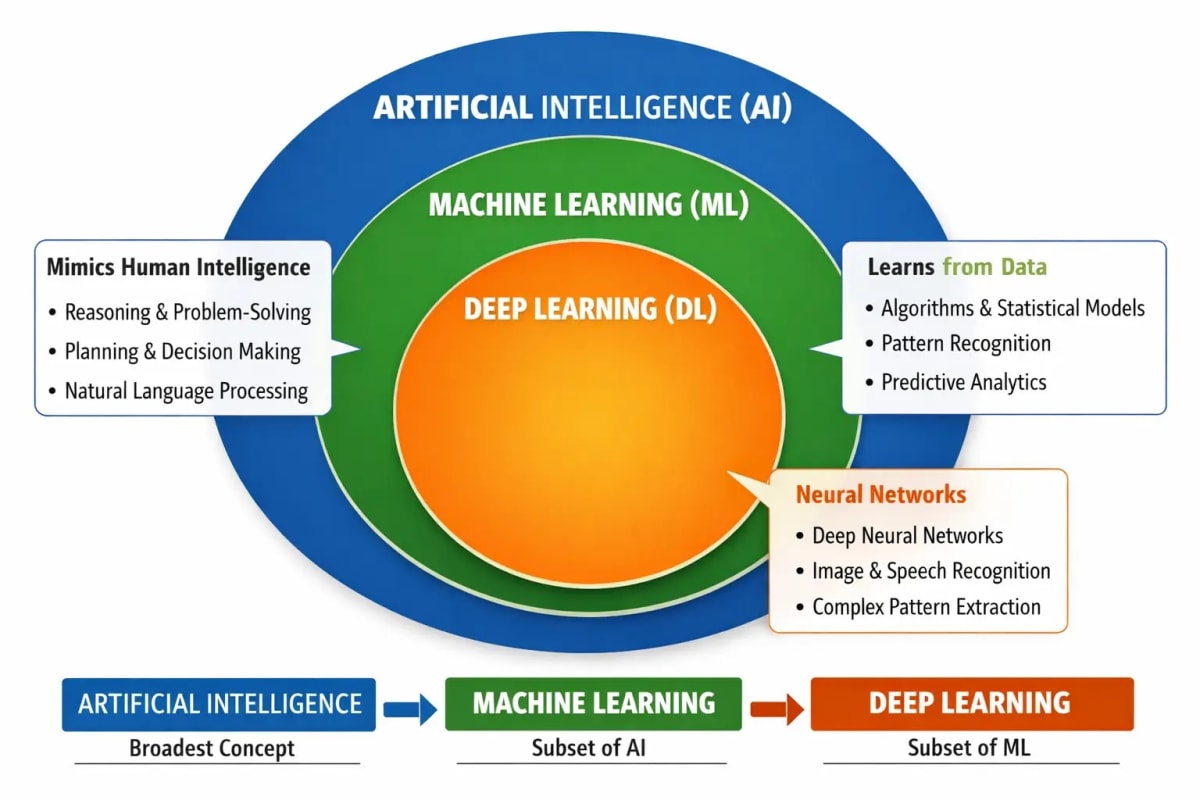
Artificial Intelligence is a city. Machine Learning is one of the major districts inside that city. Deep Learning is a specific neighborhood inside that district.
They are related. They are connected. But they are not the same place.
Every Deep Learning system is a Machine Learning system. Every Machine Learning system is a form of Artificial Intelligence. But not every AI system uses Machine Learning, and not every Machine Learning system uses Deep Learning.
That single idea is the foundation of everything else in this guide.
Artificial Intelligence is the broadest of the three concepts. It refers to any technique that allows machines to simulate human intelligence, whether that means solving problems, understanding language, recognizing patterns, or making decisions.
AI is the goal. It is the vision. The question AI asks is: can we build machines that think and act intelligently?
There are many ways to pursue that goal. Some early AI systems used simple if-then rules written by hand. Others used logic trees or expert knowledge encoded by specialists. Machine Learning and Deep Learning are simply more modern, more powerful ways of achieving that same goal.
Examples of AI in everyday life include Google Search, spam filters, navigation apps like Google Maps, virtual assistants like Siri and Alexa, and recommendation engines on YouTube and Netflix.
Machine Learning is a specific approach to building AI. Instead of programming a machine with explicit rules, you feed it data and let it figure out the rules on its own.
This is the key shift that changed everything. Traditional programming looks like this:
Input + Rules = Output
Machine Learning flips the equation:
Input + Output = Rules (learned automatically)
You give the system thousands of examples and it discovers the underlying patterns by itself. The more data it sees, the better it gets.
A practical example: instead of writing rules like "if the email contains the word lottery and asks for your bank details, mark it as spam," you show a Machine Learning model one million emails labeled spam or not spam. The model learns on its own what makes an email suspicious, often identifying patterns that no human programmer would have thought to write.

Machine Learning is used in fraud detection, medical diagnosis, price prediction, personalized recommendations, and hundreds of other applications that require finding patterns in large amounts of data.
Deep Learning is a specialized subset of Machine Learning. It uses a specific type of algorithm called a neural network, a system loosely inspired by the structure of the human brain.
A neural network is made up of layers. Data enters the first layer, gets processed, passes to the next layer, gets processed again, and so on through many layers until the system produces an output. The word "deep" refers to the depth of these layers.
What makes Deep Learning different from regular Machine Learning?
Regular Machine Learning often requires humans to manually select which features of the data the model should pay attention to. In an image recognition task, a human engineer might need to specify: look at edges, look at colors, look at shapes.
Deep Learning removes that burden. Given enough data and computing power, a deep neural network learns which features matter entirely on its own. It discovers patterns within patterns within patterns, which is why it performs so remarkably well on complex tasks like understanding speech, generating images, and translating languages.
Deep Learning is the technology behind ChatGPT, Midjourney, Google Translate, face recognition on your phone, and self-driving car systems.
Here is a clear comparison of all three across the dimensions that matter most:
| Artificial Intelligence | Machine Learning | Deep Learning | |
|---|---|---|---|
| What it is | The broad goal of making machines intelligent | A method of achieving AI through data-driven learning | A subset of ML using layered neural networks |
| How it works | Rules, logic, or learning | Learns patterns from data | Learns features automatically through layers |
| Data needed | Low to high | Medium to high | Very high |
| Computing power | Low to medium | Medium | Very high |
| Human input | High (rules written manually in traditional AI) | Medium (features sometimes selected manually) | Low (learns features automatically) |
| Best for | Broad intelligent behavior | Pattern recognition, prediction | Images, speech, language, complex data |
| Real examples | Chess programs, navigation apps | Fraud detection, spam filters | ChatGPT, image generators, voice assistants |
Q: Is Deep Learning always better than Machine Learning?
Not always. Deep Learning requires large amounts of data and significant computing power. For smaller datasets or simpler problems, traditional Machine Learning algorithms like decision trees or logistic regression often perform just as well and are far easier to interpret and deploy.
Q: Can you have AI without Machine Learning?
Yes. Early AI systems were built entirely on hand-coded rules, with no learning from data at all. Rule-based systems, expert systems, and decision trees are all forms of AI that do not involve Machine Learning.
Q: What is the relationship between neural networks and Deep Learning?
Neural networks are the core architecture used in Deep Learning. A neural network becomes "deep" when it has multiple hidden layers between the input and output. Most modern Deep Learning systems use neural networks with dozens or even hundreds of layers.
Q: Do I need to know math to understand Machine Learning?
To use ML tools and understand them conceptually, not necessarily. To build ML systems from scratch or research new methods, yes, a solid understanding of statistics, linear algebra, and calculus is important.
Q: What comes after Deep Learning?
Researchers are currently exploring areas like reinforcement learning, neuro-symbolic AI, and multimodal models that combine text, image, audio, and video understanding. The field is moving faster than ever.
Artificial Intelligence is the destination. Machine Learning is one of the main roads that gets you there. Deep Learning is a high-speed lane on that road that works best when you have massive amounts of data and powerful hardware.
They are not competing ideas. They are nested ones, each building on the one above it.
Once you see this clearly, a huge amount of the confusion around AI dissolves. Headlines make more sense. Product claims become easier to evaluate. And your ability to learn more, faster, increases dramatically.
Understanding this distinction is not the end of your AI education. It is the beginning.
Stay curious. Keep learning. The best way to understand AI is to keep exploring it.
Imagine you want to build a system that can identify whether a photo contains a cat.
With traditional AI, you would write explicit rules. "Look for pointy ears. Look for whiskers. Look for a certain body shape." This works for simple cases but falls apart quickly when the cat is in a weird angle, lighting, or partially hidden.
With Machine Learning, you feed the system 50,000 labeled photos, some cats and some not. The system learns statistical patterns that separate cat photos from non-cat photos. It works much better, but you still need to help it decide which features of the image to examine.
With Deep Learning, you feed the same 50,000 photos to a neural network. It automatically discovers that edges matter, then textures matter, then shapes matter, then combinations of shapes matter. Layer by layer, it builds its own understanding of what a cat looks like, often outperforming human-designed approaches by a wide margin.
Same problem. Three very different approaches. Each one more powerful than the last.
If you are just starting out, here is a practical recommendation:
Start with AI concepts broadly. Understand what AI is trying to accomplish and why it matters. This gives you the big picture.
Then explore Machine Learning fundamentals. Learn how models are trained, what training data means, what overfitting is, and how evaluation works. This gives you the vocabulary and mental models you will need for everything else.
Deep Learning comes after that. It is the most technical of the three and requires more mathematical foundation, though there are excellent tools today that let you experiment with deep learning without a PhD.
The good news is that every hour you spend understanding these distinctions pays dividends. The more clearly you see how these three concepts relate, the faster everything else in AI makes sense.