
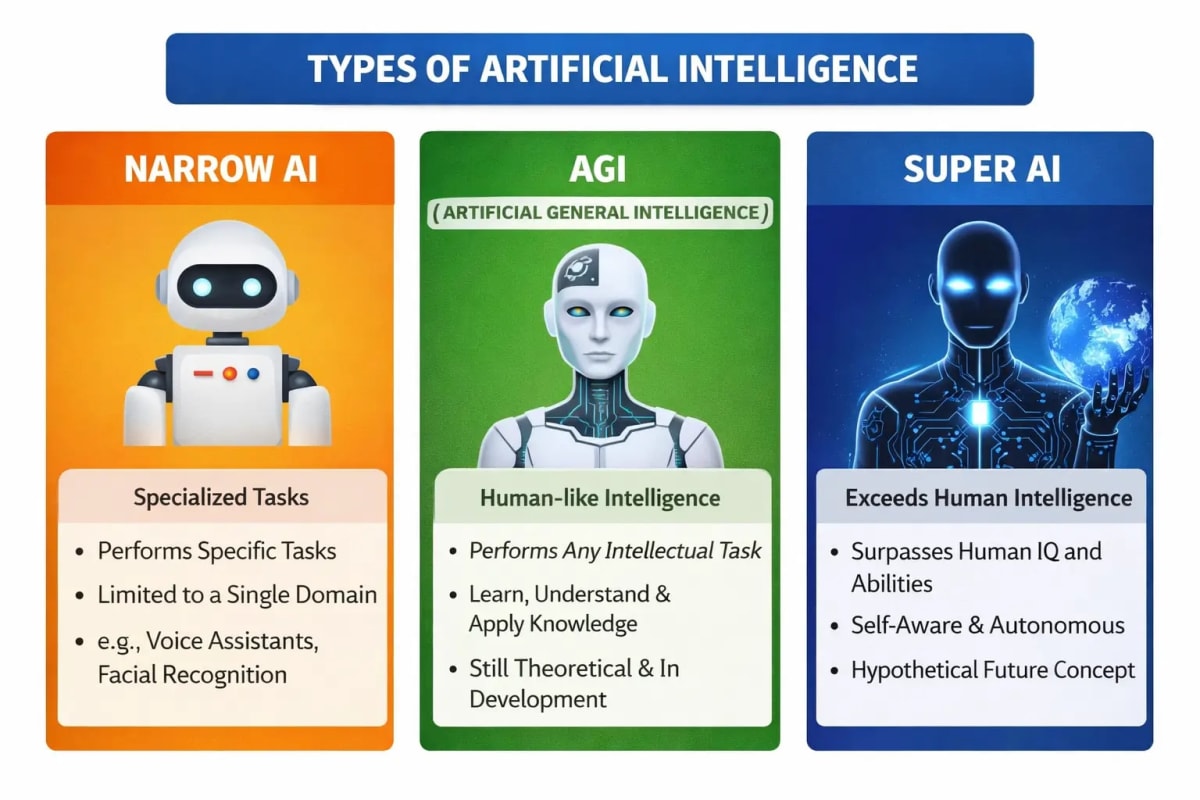
Types of AI: Narrow AI vs General AI vs Super AI

What are the types of Artificial Intelligence? Learn the real difference between Narrow AI, General AI, and Super AI with simple examples anyone can understand.
When most people hear "Artificial Intelligence," they picture one thing. A single, unified technology that either helps you write emails or eventually takes over the world, depending on which movie you last watched.
The reality is more nuanced and far more interesting.
AI is not one thing. It is a spectrum. Scientists and researchers classify AI into three distinct types based on capability, scope, and intelligence level. Understanding these three types gives you a much clearer picture of where AI stands today, what is coming next, and what the real concerns and possibilities actually are.
The three types are Narrow AI, General AI, and Super AI. Let us break each one down clearly.
Before diving into each type, it is worth understanding why this classification exists in the first place.
Not all AI systems are built the same way or capable of the same things. A spam filter and a self-driving car are both "AI," but they operate in completely different ways with completely different limitations. Lumping them together under one label creates confusion.
These three categories help us understand the gap between what AI can do right now, what researchers are working toward, and what remains in the realm of science fiction for now. That clarity is essential whether you are a student, a business owner, a policymaker, or simply someone trying to make sense of the news.
Narrow AI, also called Weak AI, is the only type of AI that actually exists today. Every AI product you have ever used falls into this category.
Narrow AI is designed to perform one specific task, or a closely related set of tasks, extremely well. It is incredibly powerful within its defined domain. But take it outside that domain and it falls apart completely.
A chess-playing AI cannot write poetry. A voice assistant cannot drive a car. An image recognition system cannot diagnose a financial problem. Each system is narrow, hence the name.
Nearly every AI tool you interact with daily is Narrow AI:
Despite its limitations, Narrow AI can be genuinely superhuman within its specific domain. AlphaGo beat the world champion at Go. IBM Watson beat the all-time champion at Jeopardy. Medical AI systems detect certain cancers from scans more accurately than experienced radiologists.
Narrow AI is superhuman at specific tasks. It is just not general.
The moment you ask a Narrow AI to do something outside its training, it has no ability to adapt, reason, or figure it out. It has no understanding of context beyond its task. It has no common sense. It simply does not know what it does not know.
General AI, often called Artificial General Intelligence or AGI, refers to an AI system that can perform any intellectual task that a human being can perform, and switch fluidly between them.
An AGI would not just be good at chess or good at language. It would be able to learn a new skill from scratch, apply knowledge from one domain to solve a problem in a completely different domain, reason about abstract concepts, understand context and nuance, and navigate the messy complexity of real-world situations.
In short: it would think like a person.
No. As of 2026, no AGI system exists. This is one of the most important facts to understand clearly, because public discourse around AI often blurs this line.
Current large language models like GPT-4 and Gemini are extraordinarily impressive. They can answer questions across many domains, write code, analyze documents, and hold sophisticated conversations. But they are still Narrow AI systems, extremely capable ones, operating within the domain of language and pattern matching. They do not truly understand, reason, or generalize the way a human mind does.
This is one of the most debated questions in all of technology. Estimates from leading researchers vary wildly:
Some believe AGI could arrive within the next 5 to 10 years, driven by the rapid scaling of compute and data. Others believe it is decades away, or that it requires entirely new approaches that have not been discovered yet. A significant group of researchers argues that AGI as typically defined may never be achievable, because human intelligence involves embodied experience and consciousness that no software system can fully replicate.
What is clear is that the pace of progress has accelerated dramatically. Problems that researchers expected to take decades were solved in years. That trend makes confident timelines difficult in either direction.
An AGI would not need separate specialized systems for every task. It could function as a universal problem-solver, a scientist, engineer, teacher, and strategist all in one. The economic and social implications would be staggering, which is why so much attention, investment, and concern surrounds the pursuit of AGI today.
Super AI, also called Artificial Superintelligence or ASI, is a hypothetical AI that surpasses human intelligence across every domain, not just matching human capability but exceeding it by a significant margin.
A superintelligent AI would be better than the best human scientists at science, better than the best human artists at creativity, better than the best human strategists at strategy, simultaneously and continuously.
No. Super AI does not exist and may not exist for a very long time, if ever. It is currently a theoretical concept discussed primarily in the context of long-term AI safety research and future forecasting.
If AGI were ever achieved, some researchers argue that it would quickly improve itself, identifying flaws in its own architecture and rewriting them to become smarter. This self-improvement cycle could, in theory, accelerate rapidly, producing an intelligence explosion that leads to superintelligence far beyond human comprehension.
This idea, often called the "intelligence explosion" or "singularity," is controversial. Many AI researchers consider it speculative. Others, including prominent figures at leading AI labs, consider it one of the most important risks humanity will eventually face, which is why AI safety research exists as a serious discipline today.
The central concern around Super AI is not whether it would be hostile in a science-fiction sense. It is more subtle and arguably more troubling. A superintelligent system pursuing any goal, even a seemingly harmless one, could cause enormous harm if its goals are not perfectly aligned with human values and wellbeing.
Getting that alignment right before such a system is built is considered by many researchers to be one of the most important unsolved problems in all of science.
| Narrow AI | General AI (AGI) | Super AI (ASI) | |
|---|---|---|---|
| Exists today? | Yes | No | No |
| Scope | One specific task or domain | Any task a human can do | Beyond all human capabilities |
| Learns new skills? | No, fixed to training domain | Yes, can generalize | Yes, and improves itself |
| Real examples | ChatGPT, Siri, spam filters | Not yet built | Theoretical only |
| Timeline | Now | 5 to 50+ years (debated) | Unknown |
| Primary concern | Bias, misuse, job displacement | Safety, control, alignment | Alignment, existential risk |
Think of it in terms of a human analogy.
Narrow AI is like a world-class specialist. A surgeon who is extraordinary in the operating room but would struggle to write a symphony or design a bridge. Exceptional at one thing. Limited beyond it.
General AI is like a brilliant, well-rounded person who can pick up any skill, master any domain, and apply knowledge across contexts. Think of the ideal polymath, curious, adaptable, capable of anything.
Q: Is ChatGPT a General AI?
No. ChatGPT is a Narrow AI. It is an extraordinarily capable language model, but it operates within the domain of text. It cannot drive a car, recognize your face, or learn a completely new skill the way a human can.
Q: Will AGI definitely be built one day?
There is genuine disagreement among experts. Some believe AGI is inevitable given the pace of progress. Others believe it requires breakthroughs that may never come. It is one of the most open questions in all of science and technology.
Q: Is Super AI dangerous?
Most researchers do not worry about science-fiction scenarios of a malevolent robot AI. The genuine concern is the alignment problem: ensuring that a superintelligent system pursues goals that are actually beneficial to humanity. Getting that wrong, even by a small margin, could have serious consequences at scale.
Q: Why do people call Narrow AI "Weak AI" if it can beat humans at chess?
The word "weak" does not mean ineffective. It means narrow in scope. A chess engine can destroy any human at chess but cannot do anything else. "Weak" refers to the breadth of its intelligence, not its performance within its domain.
Q: What is the difference between AGI and a very smart chatbot?
A smart chatbot predicts likely responses based on patterns in training data. AGI would genuinely understand, reason, plan, and generalize across domains. The difference is not just in capability but in the underlying nature of the intelligence itself.
Artificial Intelligence is not one thing. It is a spectrum with three very different points along it.
Narrow AI is here right now, already superhuman at specific tasks and reshaping industries across the globe. General AI remains the most ambitious goal in the history of technology, still unbuilt but actively pursued. Super AI is the theoretical horizon, a concept that drives the most serious conversations in AI safety research today.
Knowing the difference between these three types does not just make you a more informed reader of AI news. It makes you a more thoughtful participant in one of the most important conversations of our time.
Stay curious. Keep learning. The most interesting chapters are still ahead.
This is not a flaw in any particular product. It is a fundamental characteristic of the category.
Super AI is like that same polymath, except smarter than every human who has ever lived, in every domain, at the same time.
Understanding these three categories has immediate practical value.
When you read a headline claiming that AI will soon replace all human workers, it helps to ask: which type of AI is being discussed? Narrow AI is already automating specific tasks. But the replacement of all human cognitive work would require AGI, which does not yet exist.
When a tech CEO claims their product is close to AGI, these categories give you a framework to evaluate that claim critically. And when debates about AI safety and existential risk come up, you now understand that those conversations are primarily about AGI and ASI, not about the chatbot helping you draft an email.
The distinction matters. It helps you separate hype from reality and stay grounded in what is actually happening versus what is speculative.