Real-Life Examples of Artificial Intelligence: How AI Is Used Everyday
Real-Life Examples of Artificial Intelligence
Most people think of Artificial Intelligence as something from a science fiction movie: robots, spaceships, and supercomputers making world-changing decisions.
The reality? You are already using AI dozens of times every single day, often without even realizing it.
From the moment you wake up and check your phone to the moment you fall asleep with a Netflix show playing in the background, AI is quietly working behind the scenes of your life.
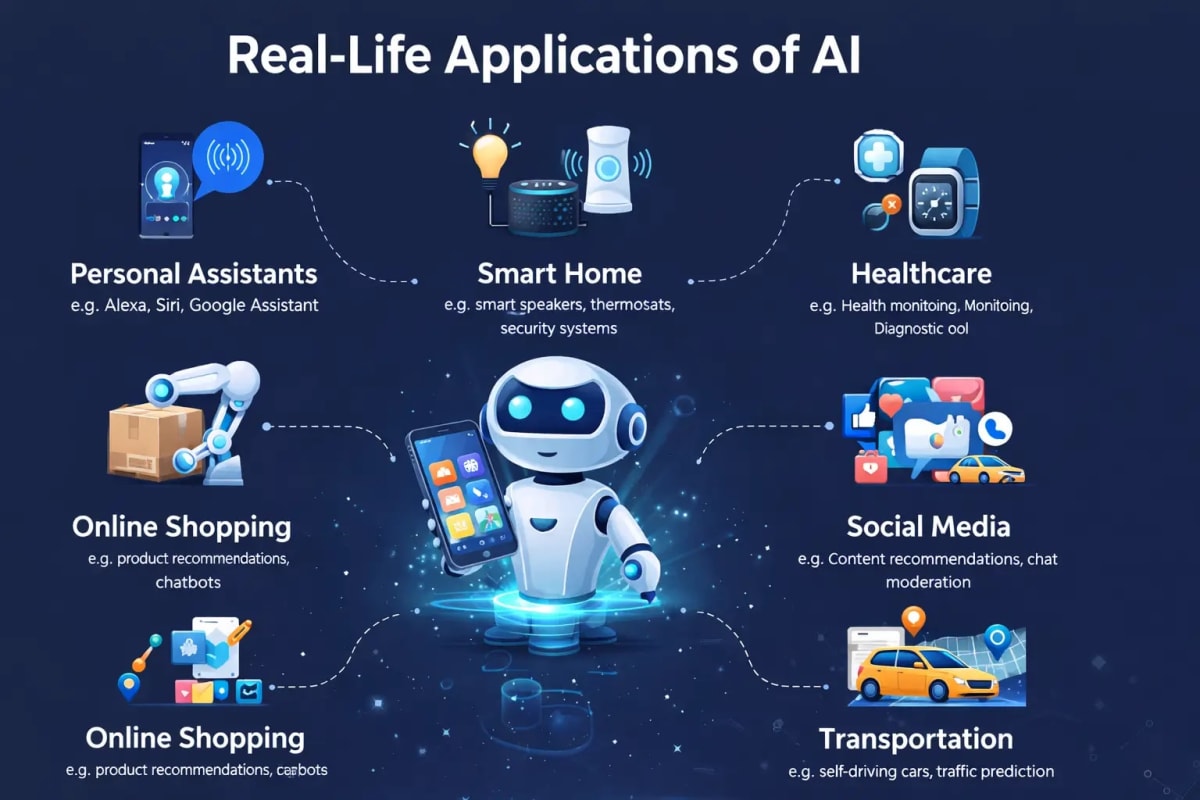
In this guide, we explore the most fascinating real-life examples of artificial intelligence across different industries, so you can see just how deeply this technology has already woven itself into everyday life.
AI is not the future. It is already part of your daily routine.
1. AI in Your Smartphone
Your smartphone is one of the most AI-packed devices on the planet.
Face ID and fingerprint unlock
Face ID and fingerprint unlock use computer vision and deep learning to recognize your unique biometric features. The model was trained on thousands of facial geometry data points and improves over time with every unlock.
Voice assistants
Voice assistants like Siri, Google Assistant, and Alexa use Natural Language Processing to understand your spoken commands, interpret your intent, and respond in natural-sounding language.
Predictive text and autocorrect
Predictive text and autocorrect analyze the words you type most frequently, the context of your sentences, and even your personal writing style to suggest what you are about to say next.
Camera AI
Camera AI automatically adjusts exposure, detects faces, optimizes portrait mode, and even identifies scenes like "food," "landscape," or "night" to select the best shooting settings.
2. AI in Entertainment and Streaming
Every time you open Netflix, Spotify, or YouTube, AI is shaping what you see next.
Netflix Recommendation Engine
Netflix uses a recommendation engine trained on the viewing habits of over 260 million subscribers worldwide. It analyzes what you watch, how long you watch it, what you pause, and what you rewatch to build a deeply personalized content feed. According to Netflix, over 80% of content watched on the platform comes directly from AI recommendations.