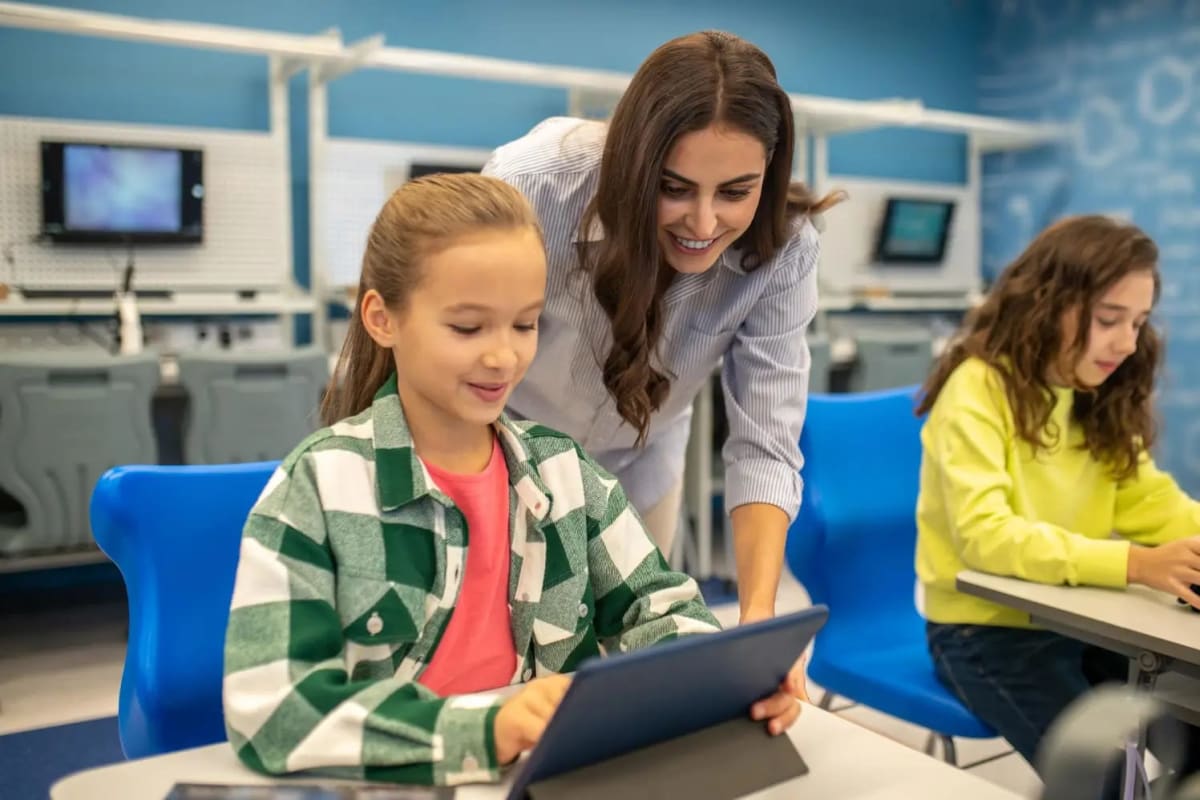
A few years ago, Mrs. Thompson, a fourth-grade teacher in Austin, Texas, spent her weekends grading 120 reading assignments by hand.
Today, she uses an AI-powered tool that handles grading in minutes, giving her time to actually sit with struggling students one-on-one.
Her story is not unique. Across the country, AI in education is quietly reshaping how students learn, how teachers
teach, and how schools operate.
But what does this shift really look like? And is it all good news? This article breaks down exactly how artificial intelligence is
changing classrooms, which tools are making a real difference, and what challenges we still need to face honestly.
What Is AI in Education?
AI in education refers to the use of artificial intelligence technologies to support, personalize, and improve the learning
experience for students and teachers. This includes tools that adapt lessons to individual learners, automate grading, provide
instant feedback, and help educators make data-driven decisions. From elementary schools to universities, AI is becoming a core part of
how education works in America.
How Artificial Intelligence Works in Schools Today
At its core, AI in the classroom uses algorithms that learn from student behavior. When a student struggles with a math problem, the
system notices. It adjusts the difficulty, offers hints, or suggests a different approach. This happens in real time, something no single
teacher can do for 30 students at once.
Schools use AI for tasks like automated attendance tracking, plagiarism detection, and even identifying students who might be at risk
of dropping out. The technology works behind the scenes, supporting teachers rather than replacing them.
Key AI Technologies Powering Modern Classrooms
Several types of AI drive these changes:
Machine learning analyzes student performance data and predicts where they need help
Natural language processing powers writing assistants and language learning apps
Intelligent tutoring systems act as virtual one-on-one tutors
Learning analytics help administrators spot trends across entire school districts
These are not futuristic ideas. They are already running in thousands of American schools right now.
How AI Personalizes Learning for Every Student
One of the biggest promises of artificial intelligence in education is personalized learning. Every student learns differently, and AI
makes it possible to tailor lessons to individual needs at scale.
Adaptive Learning Platforms That Adjust in Real Time
Platforms like Khan Academy's AI tutor and DreamBox adapt to each student's pace. If a student masters a concept quickly, the platform
moves on. If they struggle, it slows down and offers extra practice. According to a McKinsey report, students using adaptive learning
technology showed performance gains of up to 30% compared to traditional instruction alone.
This kind of real-time adjustment used to require a private tutor. Now, AI personalized learning tools bring that
experience to any student with internet access.
AI Support for Students With Disabilities and Learning Differences
This is an area most people overlook. AI is making education more accessible for students with disabilities. Speech-to-text tools help
students who cannot write by hand. Text-to-speech technology supports students with dyslexia. AI-powered translation tools break
language barriers for ESL students.
For students on the autism spectrum, AI tools can adjust sensory elements in digital lessons, reducing overload and keeping them
engaged. This is not a luxury. For many families, these tools are life-changing.
AI-powered accessibility tools are not just helpful extras. For students with learning differences, it can be the difference between
falling behind and keeping pace with their peers.
Best AI Tools for Students and Teachers
This section highlights practical tools already making a difference in classrooms and study sessions across the country.
AI Tools Students Use for Studying and Research
ChatGPT and Claude help students brainstorm ideas, explain difficult concepts, and practice writing
Grammarly catches grammar mistakes and improves writing clarity
Duolingo uses AI to personalize language lessons based on each learner's progress
Quizlet's AI features generate custom flashcards and practice tests
Socratic by Google lets students snap a photo of a homework problem and get step-by-step explanations
AI Tools That Save Teachers Hours Every Week
Gradescope automates grading for assignments, quizzes, and exams
MagicSchool AI generates lesson plans, rubrics, and differentiated materials
Otter.ai transcribes lectures and meetings automatically
Canva's AI features help create classroom presentations in minutes
PowerSchool uses AI to track student performance and flag at-risk learners
Based on a survey by the National Education Association, teachers spend an average of 7 hours per week on tasks that AI could
partially or fully automate. That is nearly a full workday returned to actual teaching.
How AI Is Changing the Role of Teachers
From Lecturers to Learning Coaches
With AI handling content delivery and basic assessments, teachers are shifting into a new role. They spend less time lecturing and
more time mentoring, coaching, and building relationships with students.
This is a welcome shift for many educators. The most meaningful moments in teaching rarely happen during a lecture. They happen during
a quiet conversation with a student who is struggling, or during a small group discussion where ideas click into place.
How AI Reduces Teacher Burnout and Administrative Overload
Teacher burnout is a serious crisis. According to a RAND Corporation study, nearly half of American teachers reported feeling burned
out by the end of the 2022-2023 school year. Paperwork, grading, and administrative reporting are major contributors.
AI for teachers directly addresses this by automating repetitive tasks. When teachers spend less time on busywork,
they have more energy for the parts of the job that actually matter, and more reason to stay in the profession.
Real Benefits of AI in Education (With Data)
Measurable Improvements in Student Outcomes
The benefits are not just theoretical. Research from Stanford University's Graduate School of Education found that AI-assisted
Tutoring improved student test scores by an average of 15% in math and reading comprehension. Schools using intelligent tutoring systems
saw the biggest gains among students who were previously performing below grade level.
Increased Engagement and Retention Rates
Students report higher engagement when lessons adapt to their level. A Pew Research Center survey found that 6 in 10 Americans believe
AI will have a major impact on education over the next 20 years. Early data from schools piloting AI tools shows improved attendance
rates and fewer students falling through the cracks.
Risks and Ethical Concerns of AI in Education
Data Privacy and Student Safety
AI tools collect massive amounts of student data, including learning patterns, performance metrics, and sometimes even behavioral
information. This raises serious questions about privacy. Federal laws like FERPA and COPPA exist to protect student data, but
enforcement has not kept pace with how quickly AI tools are being adopted.
Parents and administrators need to ask tough questions about where student data goes and who has access to it.
The Equity Gap and Digital Divide
Here is an uncomfortable truth. AI in the classroom benefits well-funded schools the most. Schools in low-income and rural areas often
lack the devices, internet connectivity, and training needed to use AI tools effectively.
If we are not careful, AI in education could widen the gap between privileged and underserved students rather than
closing it. This is one of the most important challenges policymakers need to address.
If we are not careful, AI in education could deepen the divide between well-funded and underfunded schools. Equal access to
technology and training must be part of the conversation.
Academic Integrity and AI-Generated Work
Generative AI has created a new challenge around cheating and plagiarism. Students can use AI to write essays, solve problems, and
complete assignments without learning the material. Schools are responding with AI detection tools and redesigned assessments that focus
on critical thinking rather than rote answers.
Will AI Replace Teachers?
What AI Can and Cannot Do in a Classroom
AI can grade papers, generate lesson plans, and deliver personalized content. But it cannot inspire a student who has given up. It
cannot notice when a child is going through a tough time at home. It cannot build trust, model empathy, or celebrate a breakthrough with
genuine pride.
Why Human Teachers Remain Essential
The short answer is no, AI will not replace teachers. The longer answer is that AI makes good teachers even better by
freeing them from tasks that drain their time and energy. The human connection at the heart of teaching is something no algorithm can
replicate.
AI Literacy: The New Core Skill Students Need
Teaching Students to Use AI Responsibly
Just as schools teach digital literacy, they now need to teach AI literacy. Students should understand how AI works, what its
limitations are, and how to use it as a tool rather than a crutch. This means learning to verify AI-generated information, understanding
bias in algorithms, and knowing when human judgment matters more.
How Schools Are Integrating AI Literacy Into Curriculum
Several states, including California and New York, have begun developing AI literacy frameworks for K-12 students. The goal is not to
turn every student into a programmer. It is to make sure every student can navigate a world where AI is everywhere, from college
applications to job interviews to daily decision-making.
The Future of AI in Education
Emerging Trends to Watch in 2026 and Beyond
AI-powered career guidance that matches students with paths based on their strengths and interests
Real-time language translation making multilingual classrooms seamless
Immersive AI tutors combining virtual reality with adaptive learning
Predictive analytics helping schools intervene before students fall behind
How Schools Can Prepare for an AI-Driven Future
Schools that want to stay ahead should start with three practical steps:
Train teachers on AI tools with hands-on workshops, not just webinars
Establish clear AI usage policies for both students and staff
Invest in infrastructure so every student has equal access to AI-powered learning
Schools that start investing in teacher training and clear AI policies today will be the ones leading education forward in the next
five years.
Frequently Asked Questions
AI is used for personalized learning, automated grading, student performance tracking, accessibility support, and administrative
task management in schools across the US.
AI saves teachers time, personalizes learning for each student, improves engagement, supports students with disabilities, and
helps schools make better data-driven decisions.
No. AI handles repetitive tasks and content delivery, but human teachers remain essential for mentoring, emotional support, and
building student relationships.
Key concerns include student data privacy, the digital divide between wealthy and underserved schools, and academic integrity
challenges with generative AI.
AI analyzes each student's performance in real time and adjusts lesson difficulty, pacing, and content to match their individual needs
learning needs and style.
The Bottom Line on AI in Education
AI in education is not a trend that will fade. It is a fundamental shift in how learning works. The schools, teachers, and students
who embrace it thoughtfully, with clear guidelines and equal access, will be the ones who thrive.
The technology is powerful. But the real magic still happens between a teacher and a student. AI just clears the path so that the
connection can happen more often.
Stay Ahead on AI in Education
Found this helpful? Share it with a teacher or parent who is navigating AI in education. Drop a comment below with
your experience, whether you are a student, educator, or parent. Your perspective matters.
Explore 9 proven AI predictions for 2050 backed by expert research. From AGI timelines to healthcare, jobs, climate action, and brain-computer interfaces.