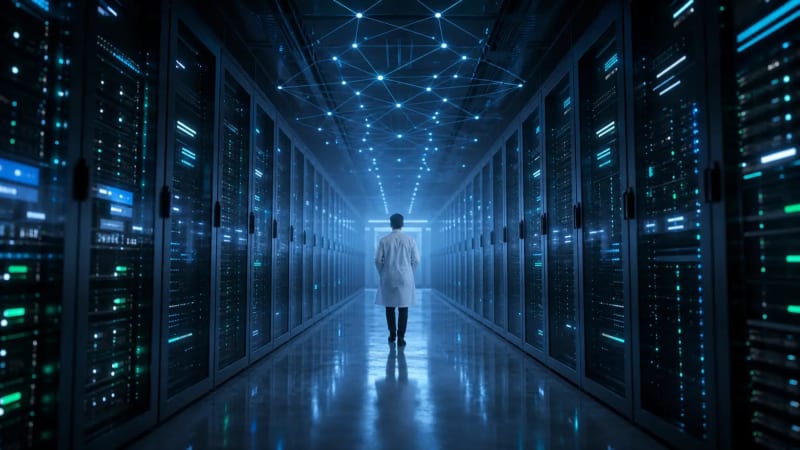
Imagine a hacker somewhere in Eastern Europe scanning millions of endpoints in under a minute. A traditional security team would miss
that signal completely. An AI-powered system would flag it in seconds. This is the new reality of digital defence, and it is changing how
every organisation thinks about safety.
AI in cybersecurity is no longer a futuristic idea. It is already protecting banks, hospitals, small startups, and cloud platforms
around the world. In this guide, you will learn how AI threat detection actually works, where it shines, where it fails, and what this
means for your job, your business, and your future online safety.
What Is AI in Cybersecurity?
AI in cybersecurity means using machine learning, neural networks, and smart automation to spot, stop, and respond to digital attacks.
Instead of waiting for a known virus signature, AI studies patterns and flags anything that feels unusual, often before the damage
begins.
How AI Differs from Traditional Cybersecurity Tools
Old security tools rely on fixed rules and known threat lists. If the attack is brand new, they often miss it. AI learns from millions
of events every day, so it can catch zero-day threats and unusual behaviour that no rule book has ever seen.
Key AI Technologies Used in Security
Machine Learning (ML): finds patterns in massive log data
Natural Language Processing (NLP): reads emails and detects phishing language
Deep Learning: spots complex malware hidden in files or network traffic
Behavioural Analytics: notices when a user suddenly acts differently
How Does AI Detect Cyber Threats in Real Time?
AI detects cyber threats by constantly learning what normal activity looks like and flagging anything that breaks the pattern. It
combines anomaly detection, behavioural analytics, and real-time telemetry across millions of events to catch attacks in seconds rather
than days.
Behavioural Analytics and Anomaly Detection
If an employee usually logs in from London at 9am, AI notices when the same account suddenly appears from Manila at 3am, downloading
large files. That mismatch triggers an alert or an automatic block.
Pattern Recognition in Network Traffic
AI studies data flowing across the network and spots subtle signs of attack, like small bursts of outbound traffic that look like data
theft. According to the IBM Cost of a Data Breach Report, organisations using AI and automation found and contained breaches around 100
days faster than those without it, saving millions of dollars on average.
Quick insight: AI does not replace rules; it layers on top of them. The best security stacks combine classic
signature detection with AI-driven anomaly scoring.
Top Use Cases of AI in Threat Detection & Prevention
AI is not one single tool. It powers many layers of modern defence.
Phishing & Email Threat Detection
AI reads tone, grammar, sender history, and links to catch phishing attempts that humans often miss. Microsoft's Digital Defense
Report highlights a sharp rise in AI-generated phishing, which makes AI-powered email filters essential, not optional.
Malware and Ransomware Identification
Machine learning cybersecurity engines compare file behaviour against billions of known samples. Even if the malware is brand new, AI
can still flag it based on how it acts.
Insider Threat Detection
AI watches for risky behaviour from inside the company, like an employee downloading huge amounts of data before resigning. This is
one of the hardest attacks to spot without automation.
Endpoint and Cloud Security
From laptops to cloud servers, AI-driven endpoint detection and response (EDR) tools monitor every process, flagging strange activity
instantly.
Proven Benefits of AI in Cybersecurity
Faster response times: attacks are stopped in seconds, not hours
Reduced false positives: smarter filtering means fewer wasted alerts
24/7 automated monitoring: AI never sleeps, never takes a break
Better scale: one AI system can watch millions of endpoints at once
Lower analyst burnout: tier-1 noise is handled by AI, not humans
The World Economic Forum's Global Cybersecurity Outlook has consistently shown that organisations adopting AI-powered defences report
stronger resilience and shorter recovery times than those relying only on traditional tools.
Real Risks and Limitations of AI in Cybersecurity
AI is powerful, but it is not magic. Honest teams admit the risks.
Adversarial AI and Prompt Injection Attacks
Attackers now use AI against defenders. They poison training data, craft inputs that fool the model, or use prompt injection to trick
AI assistants into leaking sensitive information. ENISA's Threat Landscape reports have flagged adversarial AI as a fast-growing global
concern.
Warning: Treat every AI assistant with access to sensitive data as a potential attack surface. Prompt injection and
data poisoning are already seen in the wild.
The Explainability Problem (Black Box AI)
When AI blocks a transaction or flags a user, it is not always clear why. This "black box" problem worries
regulators, auditors, and incident responders who need clear reasoning.
Data Privacy and Bias Risks
AI models need huge amounts of data. If that data is biased or badly handled, the model can unfairly target certain users, regions, or
behaviours. Privacy laws like the EU's GDPR add another layer of complexity.
Generative AI in Cybersecurity: Friend or Foe?
Generative AI is a double-edged sword. Attackers use it to write flawless phishing emails in any language, create deepfakes of CEOs,
and generate fresh malware quickly. Defenders use it to build SOC copilots, summarise incidents, and write response playbooks in
seconds.
The truth is simple: whichever side uses AI better, wins.
AI vs Traditional SIEM: A Simple Comparison
Feature
Traditional SIEM
AI-Powered Security
Detection method
Rule-based
Pattern and behaviour-based
Zero-day threats
Often missed
Often caught
Setup time
Weeks to months
Days to weeks
False positives
High
Lower over time
Analyst workload
Very high
Much lower
Best for
Known threats
Known + unknown threats
This is the section that often becomes a backlink magnet, because consultants, SaaS review sites, and training blogs
Love embedding this kind of clear comparison.
How Small Businesses Can Adopt AI Security Tools
You do not need a Fortune 500 budget to benefit from AI-powered threat prevention. A practical path looks like this:
Start with an AI-powered email security tool to block phishing
Add an EDR product with built-in machine learning
Use a managed detection and response (MDR) service for 24/7 coverage
Train staff so they understand AI alerts and trust them
Review quarterly and scale up as the business grows
Many small firms globally are using affordable, cloud-based AI security suites that cost far less than hiring a full in-house team
team.
Will AI Replace Cybersecurity Jobs?
Short answer: No, but it will reshape them. AI handles repetitive tasks like log triage, while humans focus on strategy, threat
hunting, incident response, and compliance. New roles are also growing fast, such as AI security engineers, prompt security specialists,
and MLSecOps experts.
The Future of AI in Cybersecurity
Expect autonomous SOCs where AI handles most tier-1 and tier-2 work, AI-driven zero trust networks, and tighter global regulation
around AI models. Gartner and other global research firms predict steady growth in AI-powered cyberattack defence spending over the next
several years as threats keep evolving.
FAQ
AI is used for threat detection, phishing filtering, malware analysis, behavioural monitoring, incident response, and fraud
detection across networks, endpoints, and cloud systems.
Yes. AI monitors events as they happen and can flag or block threats within seconds, which is far faster than manual
analysis.
Main risks include adversarial AI attacks, model bias, data privacy concerns, false positives, and the black box problem, where
AI decisions are hard to explain.
No. AI will automate repetitive work, but skilled analysts, threat hunters, and security engineers remain essential for strategy
and complex decisions.
Generative AI creates content like text, code, or images. In security, it powers SOC copilots for defenders and also helps
attackers craft better phishing and malware.
Conclusion
AI in cybersecurity is changing the game for defenders and attackers alike. The winners will be the organisations and professionals
who understand both its power and its limits, and who use it to work alongside skilled humans rather than replace them.
Start small, stay curious, and treat AI as a strong partner rather than a silver bullet.
Your move: If this guide helped you think differently about AI-powered threat detection, share it with a colleague or
drop a comment with the one AI security tool you want to try next. Your feedback helps us build better content for the community.
Strengthen Your Defence with AI in Cybersecurity
Pick one AI security tool this week and test it on your real workflow. Small steps build a smarter, safer
stack.
Explore 9 proven AI predictions for 2050 backed by expert research. From AGI timelines to healthcare, jobs, climate action, and brain-computer interfaces.